
Our Blog

Avoid Brushing After Every Single Meal!

July 26th, 2017
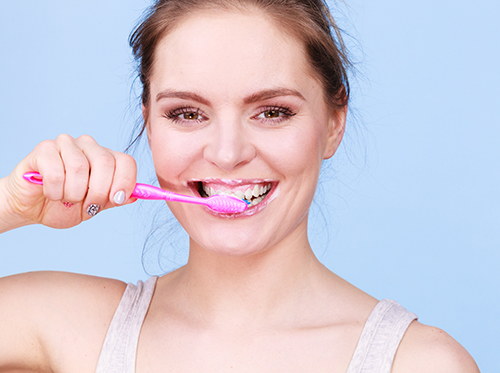
Here is some surprising yet worthwhile advice you might be hearing for the first time: Brushing after a meal can be incredibly bad for your teeth if you do it after eating certain foods.

Enamel is an extremely hard mineral on the exterior of each of your teeth. It’s actually the hardest substance in the human body: It’s even stronger than your bones! Its only weakness is that acids in the food we eat can easily destroy enamel.

Healthy teeth thrive in an environment that has the proper pH balance. That ensures your mouth doesn’t start the process of demineralization. That’s what happens when alkaline turns into acid, which attacks and softens the enamel on the surface of your teeth. Pores and fissures form, and that’s when the harmful bacteria go to work.

Our mouth’s pH level fluctuates depending on what we eat throughout the day. Examples of the most common highly acidic foods include citrus fruits, soda, and sugary foods. Highly acidic foods tip the balance of pH in your mouth from a healthy alkaline to a dangerous acid.

Can brushing your teeth immediately after a meal lead to even more damage? The answer is yes!

Eating highly acidic foods causes your teeth to be more susceptible. If you brush your teeth when they have been weakened by acids, even more destruction can happen to your enamel. Your toothbrush’s bristles will actually wear away some of your enamel. So it’s healthier to wait at least an hour after eating or snacking to brush.

Good preventive measures to take instead of brushing after you eat include:

  • Rinsing or drinking water
  • Chewing sugarless gum
  • Consuming dairy or non-acidic foods to conclude your meal

These practices help produce saliva, which in turn restores a healthy pH level in your mouth and coats the teeth with minerals they need.

Once you’ve allowed time for your mouth to be restored to a healthy pH level, you may brush your teeth as you normally would. Keep in mind that acidic foods can weaken the enamel on your teeth and take the right measures to prevent spiking pH levels.

Most important, don’t forget to wait to brush at least one hour after you eat!

Still have questions? Call our Tallahassee, FL office and schedule an appointment with Drs Marci, Glenn and Brian Beck.


Dentistry around the World

July 19th, 2017

From the clinical perspective, dentistry is similar around the world. Dentists, like Drs Marci, Glenn and Brian Beck, go to school, obtain a license, and work hard to prevent and treat tooth decay, gum disease, oral infections, throat or oral cancer, tooth loss, and other conditions that might limit a person’s ability to smile, bite, chew, or speak. The quality of dental care, however, and the payment method for dental services varies between nations.

Dentistry throughout the World

Developed countries have more dentists per capita than do developing nations, according to the World Health Organization. There is one dentist for every 150,000 people in Africa, for example, as compared to about one dentist for every 2,000 citizens of an industrialized nation. The lack of dentists in developing nations means that dental care is restricted to pain management and emergency care.

Dentistry often reflects the cultural views of a nation. Some cultures acknowledge only the functional aspect of teeth, so dentists focus on preventing tooth decay, gum disease, and tooth loss. Other cultures emphasize aesthetic appearances, so dentists there provide cosmetic procedures in addition to essential oral care.

Each nation imposes its own education and licensure requirements for dentists but most require some college before four years of dental school. The graduate must then pass local or national exams to practice in that region. European schools and standards are similar to the United States.

From the business perspective, dentistry varies between nations. In the United States, a dentist presents to the patient one bill that includes all of the treatment costs, such as the dentist, his assistant, tools, and labs. This allows the dentist to charge a single, easy-to-pay fee for individual procedures, and gives him an opportunity to mark up items and make a profit.

Across much of Europe, a dentist presents two bills to her patient – one for the dentist and another for the lab. This approach may stem from a cultural belief that profiting from healthcare is unethical and that healthcare should be available to consumers at actual cost; public dental clinics and subsidies ensures all citizens have access to dental care, regardless of ability to pay. In most cases, the government is both overseer and provider of dental care.

While the role of the dentist is nearly the same in every country – to ensure the oral health of the citizens – dental care is different in each nation. Regardless, you can rest assured that the care you receive at our Tallahassee, FL office is held to the highest standard.

Do adults need fluoride treatments?

July 12th, 2017

Many dentists and hygienists recommend fluoride treatments for their adult patients. You might ask yourself, “Do I really need a fluoride treatment? I thought those were just for my kids.” After all, most insurance plans cover fluoride treatments only up to the age of 18.

What you need to know as a dental consumer is that studies have shown topical fluoride applications performed by a dental professional create a significant benefit for adults who have moderate to high risk for cavities.

There are several circumstances that warrant extra fluoride protection among adults. Many prescription medications reduce saliva flow or otherwise create dry mouth. A reduction in saliva increases cavity risk.

Adults often experience gum recession, which exposes part of the root surface of teeth. These areas are softer than the hard enamel at the top of the tooth, which makes them more susceptible to decay.

In addition, adults often get restorative work such as crowns or bridges. Fluoride can help protect the margins of these restorations, ultimately protecting your investment.

Today many people opt for orthodontic treatment (braces) as adults. Braces make it more challenging for patients to maintain good oral hygiene. Just ask your kids! Fluoride can keep the teeth strong and cavity-free even with the obstacle of orthodontic appliances.

Have you had a restoration done within the last year due to new decay? If you have, that puts you at a higher risk for cavities. Fluoride treatments are a great way to prevent more cavities in patients who are already prone to them.

How is that flossing coming along? You know you should floss daily, but do you? If your oral hygiene is not ideal, fluoride could be just the thing to keep your neglect from leading to cavities between your teeth.

Fluoride can also help with the growing problem of sensitive teeth. Diets high in acidic foods and beverages, general gum recession, and increased use of whitening products all tend to produce sensitive teeth. Fluoride treatments re-mineralize tooth enamel and reduce that sensitivity.

Patients who undergo radiation treatment for cancer also benefit from topical fluoride applications. Radiation damages saliva glands, thus greatly reducing the flow of saliva. Saliva acts as a buffer against the foods we eat and beverages we drink. Once again, less saliva greatly increases the risk of cavities.

If one or more of these conditions applies to you, consider requesting a topical fluoride treatment. Be sure to ask Drs Marci, Glenn and Brian Beck at your next appointment whether you might benefit from a topical fluoride application.

Tell us about your summer!

July 5th, 2017

The dog days of summer are upon us, and what better time for Drs Marci, Glenn and Brian Beck and our team to ask our patients about their summer!

Whether you visited our nation’s capital, went on a camping trip, or just stayed in Tallahassee, FL and relaxed, we want to know how you’re all spending your summer! Please feel free to share your summer plans and experiences with us below or on our Facebook page as summer rolls on!

Practice Contact Information